
Middleton's Roman Milestone
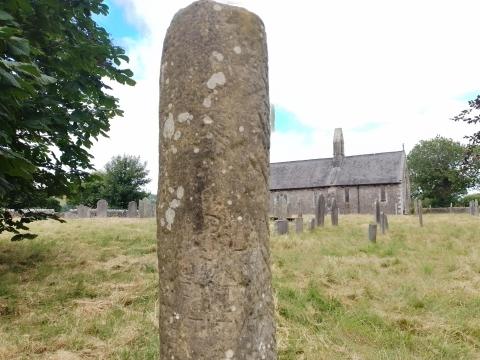
At Middleton near Sedbergh is found a Roman milestone. It was first discovered in 1836 by Richard Bownass of Hawkin Hall, who had ploughed it up and arranged for it to be re-erected, but not before adding his own inscription to commemorate the great event, which he described as "restoring it from the soil".
Ten years ago, cattle knocked it over again; two centuries of use as a scratching post proved too much. It was therefore relocated some 220 yards east into the grounds of the Church of the Holy Ghost. Fewer cattle are likely to brush against it here, and neither are people likely to be plentiful, seeing as the church is all but redundant.
Its cylindrical sandstone shaft has been dated to AD300 and, as well as Mr Bownass’ diatry entry, it has upon it the letters 'M (milia) P(passuum) L lll'. i.e. 53 miles, and likely refers to the city of Luguvallium, which we know as Carlisle, and occupied a site roughly 50 miles to the north (Roman miles and English miles are not exactly the same). Several Roman forts were constructed in this area and this pillar may have been for the legionaries' benefit as they travelled to and fro.
The re-siting to a churchyard I think was both wise and practical, but is also offers a spiritual lesson. The empire of Rome is long gone, and British Christianity, as exemplified by the empty church, is fast fading away. Yet within its decaying structures and ancient ruins, the Holy Ghost remains at work, gently wooing, drawing, convicting and pointing sinful Britons to the glorious gospel. Many drive past this pillar oblivious to its presence and information, which it has faithfully shared these past 1700 years. Likewise, the Church of Jesus Christ, though ignored and sidelines, continues to offer worship to the Living God and shares the scriptures, even though the re-paganised English are basely unlearning much that former generations knew so well.
Therefore the Lord himself shall give you a sign; Behold, a virgin shall conceive, and bear a son, and shall call his name Immanuel. Isaiah 7:14
A D
- Log in to post comments
 Sunday Worship 10.45am & 6.00pm