
Pleasington Priory
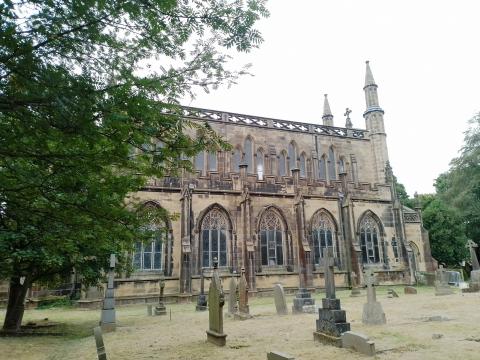
Pleasington is one of those places where one of Blackburn’s ethnic minorities may be found: its white, middle-class. I was last there fifteen years ago while taking three old ladies from church to the Butler’s Arms for lunch. I remembering blanching at the prices; had I called last month, I suspect I would have fainted. Yet I was there not for food but to see its most famous church: Pleasington Priory.
Why the Roman Catholic Church of St Mary and St John the Baptist should be styled a priory, I do not know. It has no prior and it does not stand on the site of a former monastic house, either. I suspect the name was awarded to give it an even more Romanist feel, as though the architecture needed this. I was unable to gain entry to the insides, which is fairly unusual for a Catholic place of worship, seeing as its regulars are encouraged to come mid-week to confess, genuflect, pray and all the rest.
Built around the same time as Salem Chapel around 1817, it enjoyed a much larger budget (£23,000 in contrast to our £500). This money came from the deep pockets of a gentleman rather than the pooled resources of weavers and farmers. Its benefactor, John Francis Butler, claimed to have had a life-threatening accident on that very spot from which he made recovery and paid for the church as thanks. He also arranged for a sculpted bust of himself in military uniform to peer out above the main entrance just in case anyone directed the whole of their gratitude to God, and forgot the large purse from which the bill was settled.
Despite its boldness, lavishness and confidence, even in those days prior to Catholic Emancipation when members of that Church were hindered and disadvantaged by state-sponsored Anglicanism, many of the graves and memorials which I inspected had upon them inscribed pleas for ‘charity’. Passers-by, loved ones, regulars and even gardeners, it might be hoped, might say a prayer for the one named. And why? That they might escape the flames of purgatory, and be granted relief from the agonies of their half-bought salvation. For all the beauty associated with Roman worship, it offers only qualified hope. Jesus died on the cross for sins, but they must burn off their own in purgatory; Jesus came to bring them salvation, but He cannot be approached except through saints, popes, priests and masses. Little wonder that the gravestones are timid even in the shadow of that exuberant, self-assured building.
Come unto me, all ye that labour and are heavy laden, and I will give you rest. -Jesus Christ, in Matthew 11:28
A D
- Log in to post comments
 Sunday Worship 10.45am & 6.00pm