
Queen Jane, Bishop Hooper & The New Inn
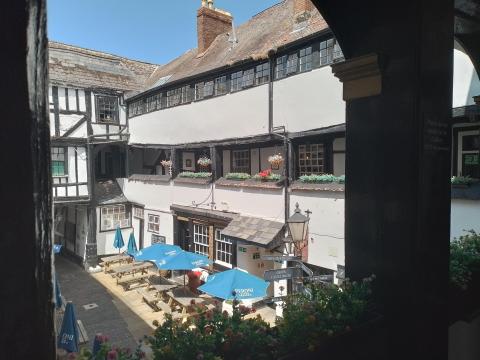
I had a number of the younger people round for supper after the service on Sunday evening. We discussed whether Gloucester, the morrow’s port of call, was in the south or the midlands. We opted for the south. And so here I am. I booked it some time ago, and, contrary to my custom, I am staying in a rather salubrious room. Whether I had previously entertained some possibility of winning the Pools, or whether the experience of a cheap, small room was still chaffing, I opted for something better than my usual, I cannot recall, but I write this was a room which is actually rather nice.
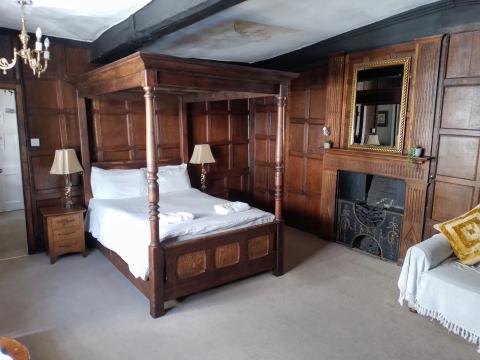
Gloucester’s New Inn, despite its name, is medieval, rebuilt in 1450 to replace its predecessor, the old inn. The door to my room is approximately fifteen feet from the spot from which Jane Grey was proclaimed Queen on 10th July, 1553, by a royal official. New Inn is a good example of a timber framed medieval courtyard inn with an external gallery, from which my room is accessed. Poor Jane’s reign was too short and her life concluded with tragedy, but, somehow, I rather like being so close to a place where her name was officially pronounced. My room has an uneven floor and the wooden panelling is in danger of making one seasick on account of the wonky dimensions, but it has somehow helped me to connect to these times of tried faith.
Another reason for coming to Gloucestershire is to pay respects to another of the ‘Marian Martyrs’, John Hooper, Gloucester’s second bishop. An evangelical whose theology bordered on the radical, he even objected to the wearing of special, episcopal vestments. He was zealous about his diocese, faithfully engaging in visitation rather than playing high politics at Whitehall. He also had a genuine concern for the plight of the poor, for he lobbied on their behalf. When England’s Josiah died and wicked Jezebel took the throne, he was Elijah, and the first one she came for.
Both Jane and John had known what it was like to live in palaces while they were on earth. Although their evangelical principles had persuaded them exchange them for prisons, their respective executioners released them to somewhere far better. Although imprisoned elsewhere, Hooper was returned to this city of Gloucester so the townsfolk could see what happened to their evangelical bishop, so they might note their own likely plight if they returned to the reformed faith.
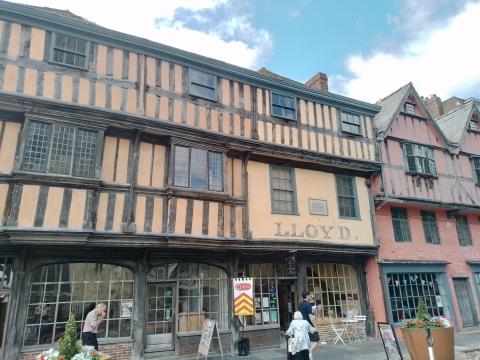
He was held in the house upon which the word Lloyd is written, above, before being led the following morning to a place outside the cathedral precincts (below) where he was chained to a stake (part of which survives and is displayed in the museum) and burnt to death. Appallingly, it took three attempts to make his fire hot enough to burn him; in his agony, he even asked them to get the fire going so they could get it done with. After a further 45 minutes of pain, “he endured the fire with the meekness of a lamb, dying as quietly as child in his bed”. I find that hard to believe, but the good bishop was a remarkable man. Although I have written about queens and bishops, it gives me little pleasure to share that this place of execution, upon which this fine monument was subsequently erected in 1862, is also where Thomas Croker, the bricklayer, and Thomas Drowry, a blind boy who had visited Hooper the day before he was killed, also fuelled the Pope’s bonfires. Truly, the world was not worthy of them.
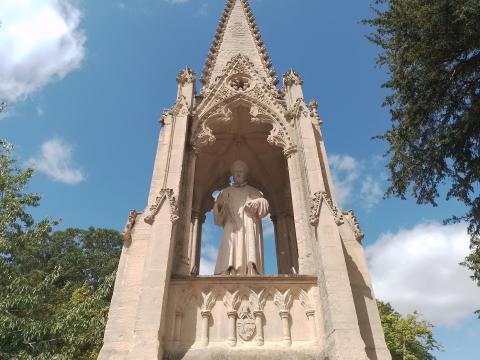
A teenaged queen, a godly bishop, a bricklayer and a blind boy: each dispatched in a cruel and agonising manner, and each one received in turn by the Lord of Glory for whose honour and gospel they offered their lives.
More through happy coincidence than thoughtful design, my train journey reading was Eamon Duffy’s 2009 Fires of Faith: Catholic England Under Mary Tudor. His argument, thus far, has been to revise the long held belief that Bloody Mary’s reign was characterised by incompetence and the use of pure force in its mission to return England to papal darkness. Rather, her regime employed a range of successful means to re-catholicise the kingdom, which, judging by the number of evangelicals who reconverted to Rome, was highly successful.
And this makes the martyrdom of our four the more, not the less, remarkable.
Fear none of those things which thou shalt suffer: behold, the devil shall cast some of you into prison, that ye may be tried; and ye shall have tribulation ten days: be thou faithful unto death, and I will give thee a crown of life. Revelation 2:10
A D
- Log in to post comments
 Sunday Worship 10.45am & 6.00pm