
Coming from the Mill (1930)
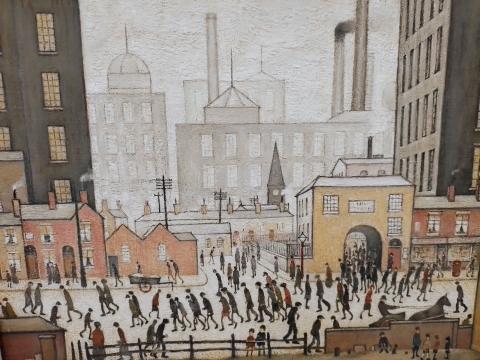
Lowry’s Coming from the Mill (1930) shows some of the interesting architectural styles available to a northern, industrial town, from redbrick factories, blackened churches and elevated mills with large windows and gigantic chimneys. The people who scutter back and forth, however, all look rather similar. Apart from some dull red coats and the odd dash of dark green, their flat caps and cloche hats combine with their characteristically stooped posture, giving them a sense of uniformity rather than mere similarity. Perhaps Marx’s analysis that industrialisation dehumanises the worker and makes him part of some faceless lump or class rather than a collection of individuals is here depicted.
Although industrialisation may not be inherently sinful, it does seem to be a natural consequence of the Fall. Making, re-making and mending: dirt, grime, danger and soot, offering rather unfulfilling lives in which so many labour to make a few even wealthier. Humans are not mere ants or drones, we are people made in God’s image, wrecked and ruined by the Fall, but saved and redeemed by Christ. ‘Tis a pity Lowry was not able to depict the twice-born, those given new purpose, new hope and new life by the gospel. Their shoulders might be straighter, their colours more vivacious, their destinations rather more interesting.
Wherefore do ye spend money for that which is not bread? and your labour for that which satisfieth not? hearken diligently unto me, and eat ye that which is good, and let your soul delight itself in fatness. Isaiah 55:2
A. D
- Log in to post comments

 Sunday Worship 10.45am & 6.00pm