
Leicester's Abbey, Knighton's Night
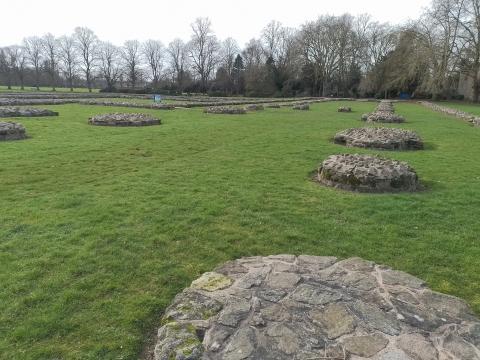
Leicester Abbey is now a series of extremely low walls and exposed foundations, for it was dissolved at the great Reformation, its monkish inmates pensioned and dispersed. Known as the burial place of Cardinal Wolsey, it was also home to a man of lesser fame whose writings well reflect the Church of Rome, Henry of Knighton. He composed a lengthy chronicle in the fourteenth century, including a brief section on great John Wycliffe, the man who translated the scriptures from Latin to plain English:
"This Master John Wyclif translated into the Anglic [English] -not Angelic-tongue, the Gospel that Christ gave to the clergy and the doctors of the Church, that they might minister it gently to laymen and weaker persons, according to the exigence of their time, their personal wants, and the hunger of their minds; whence it is made vulgar by him, and more open to the reading of laymen and women than it usually is to the knowledge of lettered and intelligent clergy; and thus the pearl of the Gospel is cast forth and trodden under the feet of swine.”
See the sheer disdain and snobbery he had for the common folk and his appalling ignorance of the facts, such as his claim that God gave the gospel "to the clergy". Interesting a writer though he is, his spiritual darkness is evident. The days were coming, thank God, when the canons of Leicester would be no more and their high walls torn down, while Wycliffe’s doctrines and Biblicism would characterise, to a greater or lesser degree, the Church in England.
Those have turned the night into day; and again after darknesses hope [for] light. Job 17:12, Wycliffe's translation.
A D
- Log in to post comments
 Sunday Worship 10.45am & 6.00pm