
Maggie Wall's Monument
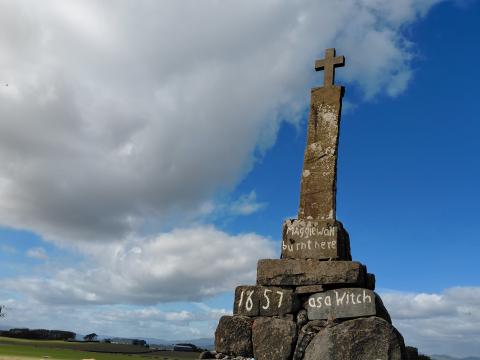
A rather eery monument stands on a quiet road in Perthshire near the village of Dunning. At first glance it appears much like a war memorial, with a raised cross and wider base, but it is older and a little cruder. Daubed in modern, white paint, are the words
Maggie Wall burnt here
1657 as a Witch
Witches in England were typically hanged as it was deemed to be a criminal offence rather than burnt (which was reserved for heresy), but I have less knowledge of the Scottish scene, and the Scots, who do nothing by halves, might well have opted for the more excruciating form of execution. Curiously, there are no historical records for the death, nor even for Wall’s existence. This has caused some to doubt the tale’s authenticity, though local lore should not be automatically discounted, for someone certainly went to some trouble to erect this monument in the following century. Some consider Maggie Wall to be a single, symbolic personification of all the women so cruelly condemned in Scotland from the late medieval to the early modern periods.
As we drove away, I pondered the year: 1657. The 1650s strike me as a golden age, for Cromwell and his puritans were governing both England, Ireland, Scotland and Wales. Yet this terrible event, assuming it was real, happened on their watch. This will confirm in the minds of critics of Cromwell and the puritans that they were as cruel and fanatical as they imagine. Ironically, witch trials declined under the Cromwellian occupation of Scotland; English circuit judges were less readily impressed by evidence for witchcraft than Scottish Justices of the Peace, whose judicial powers had been curtailed by the English invaders. Of 3,800 woman and men to have been executed for witchcraft, very few occurred under Cromwell’s rule. By 1656, however, the English government had restored Sherrif’s courts and Scottish judges in order to gain a wider acceptance from the landholding elites. This was good news for gentry, but bad news for the Maggie Walls up and down the land whose judges were bitter Kirk-Presbyterians rather than English Independents. It was not puritanism which provided the impetus for these horrific trials and executions, but the Scottish Kirk, that rather brutal and heartless organisation which claimed the name of Christ and, ironically, often preached it, faithfully.
A true Christian reads God’s word and loves his enemies, using his powers and influence wisely for the common good, shielding the weak and protecting the widow. Maggie Wall may not have been real, but there were thousands of others who were real enough. May God have mercy on those who murder in the name of righteousness.
He hath shewed thee, O man, what is good; and what doth the Lord require of thee, but to do justly, and to love mercy, and to walk humbly with thy God? Micah 6:8
A D
- Log in to post comments
 Sunday Worship 10.45am & 6.00pm
