
Morecambe Parish Church
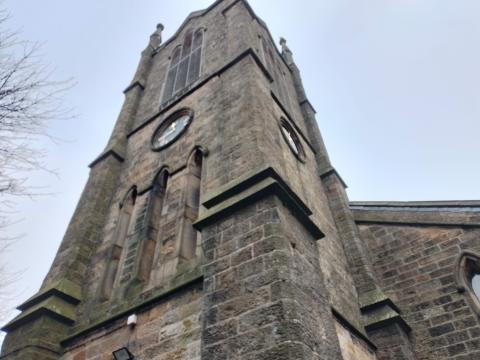
I have never been able to enter Holy Trinity Church at Morecambe. For good reason, perhaps, it tends to keep its doors locked mid-week, despite being a stone’s throw from the town’s police station. Although Queen Victoria made a personal contribution towards the cost of construction, nothing externally excites my interest; built by 1841, it enjoys the Early English style with its narrow lancet windows.
Its predecessor, however, was more interesting. The current early Victorian edifice replaced a smaller, humbler chapel of ease constructed in 1745. The land had been willed for the purpose by Francis Bowes, the blacksmith of Poulton-le-Sands, which was one of the three villages which eventually made the town of Morecambe. He died in 1742, but his legacy essentially allowed the people of Poulton a place of Anglican worship for a century. The current edifice is tall and grand, paid for, in part, by a Queen, but its origins lay in the grit, bangs and sparks of a village smithy.
Just as a lad brought to Jesus Christ a packed lunch which became one of the most famous miracles in history, and Master Bowes helped to found a village church attracting royal attention, so our tiny offerings and simple acts of service the Lord is pleased to both receive, employ and then magnify.
And let us not be weary in well doing: for in due season we shall reap, if we faint not. Galatians 6:9
A D
- Log in to post comments
 Sunday Worship 10.45am & 6.00pm